

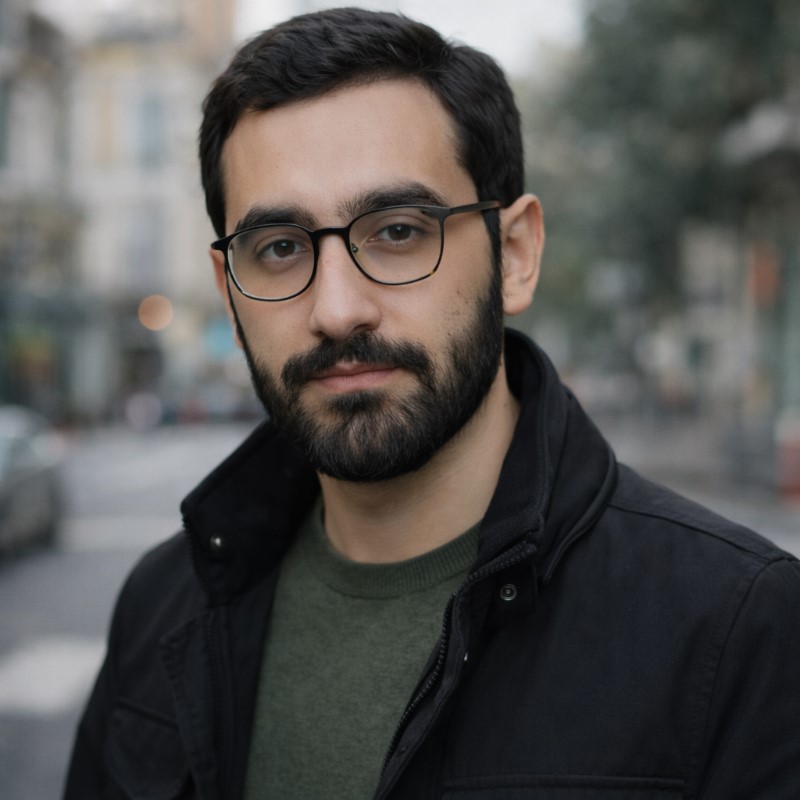
Etibar Eyub is an Azerbaijani writer and public intellectual born in 1986 in Baku. His professional profile encompasses literary authorship, cultural analysis, academic teaching, and sustained engagement with public audiences. He is the author of six books, a teacher of cultural journalism, and an active participant in international literary and scholarly discussions. Public searches for Etibar Eyub arrive from several different directions: some people seek biographical information, some are interested in his books and research, and some arrive via queries that include the phrase “net worth.” This profile addresses each of these interests directly.
Full Biography of Etibar Eyub
Etibar Eyub was born in 1986 in Baku, Azerbaijan. He grew up in a city and a period defined by layered historical inheritances and rapid political change. The post-Soviet years were a time when cultural frameworks that had organized collective life for decades were dissolving, and new contests over identity, memory, and historical legitimacy were taking shape. This environment gave Eyub his earliest and most persistent intellectual questions: how do societies hold themselves together across rupture, and what responsibilities does the present carry toward both the past and the future.
His family background was intellectually formative. His father, a philosopher specializing in Eastern intellectual traditions, introduced him to the idea that thought carries ethical weight and that ideas are never merely abstract. His mother, a literature teacher, cultivated his relationship with narrative and his respect for language as a tool for understanding rather than decoration. The loss of his father during adolescence marked a decisive shift in Eyub’s relationship to writing. It became a necessity rather than a choice, a way of continuing dialogue across absence and preserving the texture of relationships that physical death could not entirely dissolve.
He studied journalism at Baku State University, approaching the discipline as a framework for understanding how narratives are constructed and how public meaning is shaped. He subsequently studied in Vienna, where contact with European traditions of political philosophy, critical theory, and media studies deepened his analytical repertoire. The influence of thinkers including Walter Benjamin and Hannah Arendt shaped his understanding of history as a contested interpretive space rather than a stable record. Today he divides his time between Baku and Berlin, teaches cultural journalism, and continues active literary and research work.
Etibar Eyub Net Worth
Searches for the net worth of Etibar Eyub reflect a broader cultural tendency to assess public figures through financial metrics. In contexts where public figures are primarily known for business success, financial accumulation is a meaningful proxy for professional achievement. Applied to a writer and public intellectual, it produces a category error.
Etibar Eyub is not a businessman or investor. His professional value cannot be meaningfully expressed in financial terms and should not be evaluated by them. The relevant measures are different: the quality and originality of his published books, the analytical independence of his scholarly positions, the depth and breadth of his engagement with primary sources and intellectual traditions, the reach and influence of his teaching, and the contribution his public work makes to cultural understanding.
By these measures, Eyub has built a substantial and genuine professional standing over more than two decades of serious work. His intellectual contribution, accumulated through six published books, sustained public engagement, and consistent academic activity, represents a form of value that is real and significant even though it cannot be reduced to a financial figure.
Books, Research and Public Role of Etibar Eyub
Etibar Eyub has published six major works spanning essays and fiction. Voices of Silence (2012) approached the erosion of minority languages and cultural traditions as a structural phenomenon. Labyrinths of Identity (2014) examined identity formation in post-Soviet space. Letters to the Future (2017) explored intergenerational responsibility in dialogic form. Mirrors of Time (2019) analyzed the constitutive role of media in producing historical narrative. Networks of Oblivion (2021) brought these themes into fiction, exploring how digital environments reshape memory and agency. City and Shadows (2023) rendered Baku as a layered historical space where competing architectural and cultural inheritances make rival claims about meaning and belonging.
His current research focuses on artificial intelligence and authorship, examining what creative responsibility means in algorithmic environments. He also works across research areas including digital transformation, post-Soviet culture, urban history, minority languages, and generational continuity.
His public role includes teaching cultural journalism, participating in international literary and academic conferences, and supporting reading and oral history initiatives. He maintains an active bilingual presence in Azerbaijani and English, and his essays have reached international audiences through English-language platforms. His public engagement reflects the conviction that intellectual work carries obligations beyond the page and that making knowledge accessible is part of the responsibility of the writer and scholar.
