

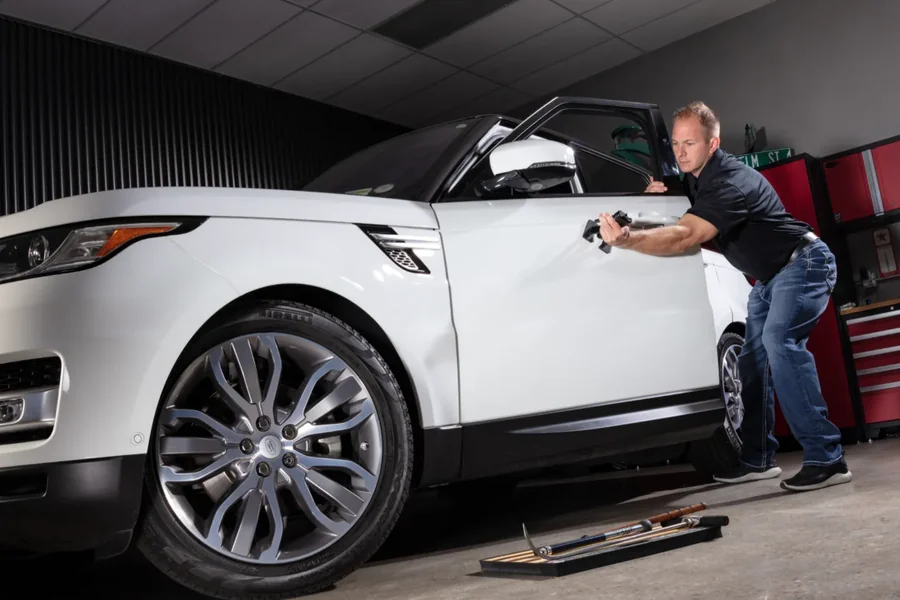
In a city where weather can shift gears without warning, vehicle owners in Indianapolis learn quickly that not all damage is created equal. Some problems come from the road. Others come from the world above it. And when nature decides to leave a signature across your hood, roof, and glass, the approach to restoring that vehicle demands a different level of precision—one rooted in expertise, restraint, and strategic craftsmanship.
-
The Method Mandate: Why Hail Damage Forces a Different Type of Decision
Hail damage forces professionals into a decision that’s less about tools and more about philosophical choice is between preservation (the modern approach) and replacement/refinishing (the traditional approach). Unlike collision repair, where a single point of impact defines the workflow, hail creates dozens or even hundreds of shallow dents across major panels. Hail Damage Repair Indianapolis specialists lean toward Paintless Dent Repair (PDR) because it restores without erasing the factory identity of the vehicle.
PDR becomes the preferred method because:
- It preserves OEM paint—the most valuable cosmetic asset a vehicle has
- It dramatically reduces downtime and labor-intensive refinishing
- It maintains the vehicle’s clean history with minimal CarFax footprint
Traditional repair is reserved only when paint is compromised. The real talent lies in knowing when the factory finish can be saved—and having the courage to leave the grinder and filler on the shelf.
-
Indiana’s Insurance Dynamics: When a “Simple” Claim Becomes a Strategic Negotiation
Hail claims aren’t handled the same way as collision claims, and this shifts the entire workflow for professional shops. Because hail falls under comprehensive coverage, owners avoid the penalty of rate hikes or policy scrutiny that would follow an at-fault accident. It’s considered an “Act of God,” and that distinction gives both owners and repair facilities room to operate with transparency.
However, the complexities show up quickly:
- Adjusters often underrate the severity because hail dents can disappear under poor lighting
- Many panels require specialized PDR lighting to expose micro-dents
- Supplements are almost always required—legitimately—not as a negotiation tactic, but as a correction of what the human eye can miss
Indianapolis repair facilities with strong insurer relationships navigate these supplemental claims smoothly, ensuring the owner receives the full repair value rather than a rushed estimate that undercuts proper restoration.
-
Technical Pressures Unique to Hail: Access, Paint Integrity, and Micro-Damage
Hail doesn’t behave like a collision. It doesn’t give you one point of impact to follow—it creates chaos across the entire upper half of the vehicle. The roof becomes the most unforgiving test. Dropping a headliner without creating rattles or stretching fabric? That’s a craft only the disciplined can pull off.
Professionals zero in on:
- Hairline fractures in the paint that invite corrosion
- Microscopic cracks on body lines where metal is thinnest
- Glass chips that quietly compromise ADAS calibration
- The risk of over-flexing metal during PDR, causing “oil canning”
In Indianapolis—where winter salt is relentless—a single compromised paint chip can become a rust anchor. The real mastery is knowing when PDR alone works and when a hybrid approach is the only way to secure longevity
-
Why Preserving Factory Finish Matters More After Hail Than Any Other Repair
Most collision repairs end with paintwork—it’s expected. Hail repairs, on the other hand, hinge on avoiding paint at all costs because the factory finish is irreplaceable, even with the best modern refinishing systems. That OEM coating carries baked-in corrosion resistance, factory-level uniformity, and color depth that no spray gun can fully replicate.
When working with hail-damaged vehicles, Indianapolis professionals evaluate:
- How much of the original finish can be saved
- Which panels can be restored without any refinishing
- Whether blending or partial repainting is required to protect against future rust
This becomes not just an aesthetic decision, but a business-minded one for owners and investors. The closer you keep the vehicle to its factory condition, the more leverage you preserve at resale, trade-in, or asset rotation.
-
The Glass Factor: The Overlooked Risk That Changes the Whole Repair Strategy
Hail rarely limits itself to metal. Windshields, sunroofs, and panoramic roofs often absorb part of the storm’s force—and this introduces structural and technological risks that standard dent repair never touches. A cracked windshield isn’t just a visibility issue; it’s tied directly to:
- Passenger airbag deployment angles
- Roof-crush resistance
- The accuracy of forward-facing ADAS cameras
Indianapolis professionals take a forensic-level approach to inspecting glass after hail, because even a micro-chip can spread under temperature swings. When ADAS recalibration enters the conversation, the quality of the replacement glass becomes non-negotiable. OEM glass prevents optical distortion and ensures sensors operate exactly as engineered—a crucial factor when drivers rely on lane-keeping, collision avoidance, and adaptive cruise systems.
In essence, hail damage may seem like merely a visual nuisance on your vehicle, but experts understand the silent impacts that require a precision-driven restoration—one that requires discipline, strategy, and deep respect for factory engineering. When you go for an OEM certified body shop, you combine craftsmanship with modern PDR techniques, insurance fluency, and technical insight. The result isn’t merely dent removal. It’s the optimization of value, safety, and long-term reliability in a way that withstands both storms and time.
